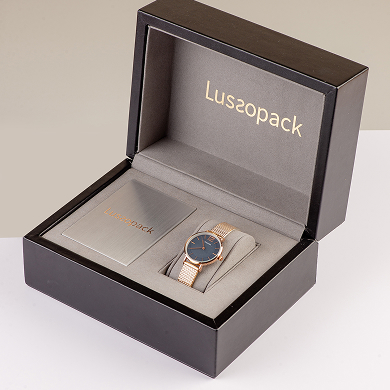
Switzerland’s watch market is built on precision, quality and presentation. For retailers, the watch box is not only part of the customer experience but also an important procurement decision.
When ordering watch boxes wholesale, buyers need to look beyond the unit price. MOQ, pricing tiers, lead times, quality control, shipping terms and total landed cost can all affect the final value of an order.
Understanding these factors before production can help Swiss retailers reduce risk, control costs and choose the right packaging supplier.
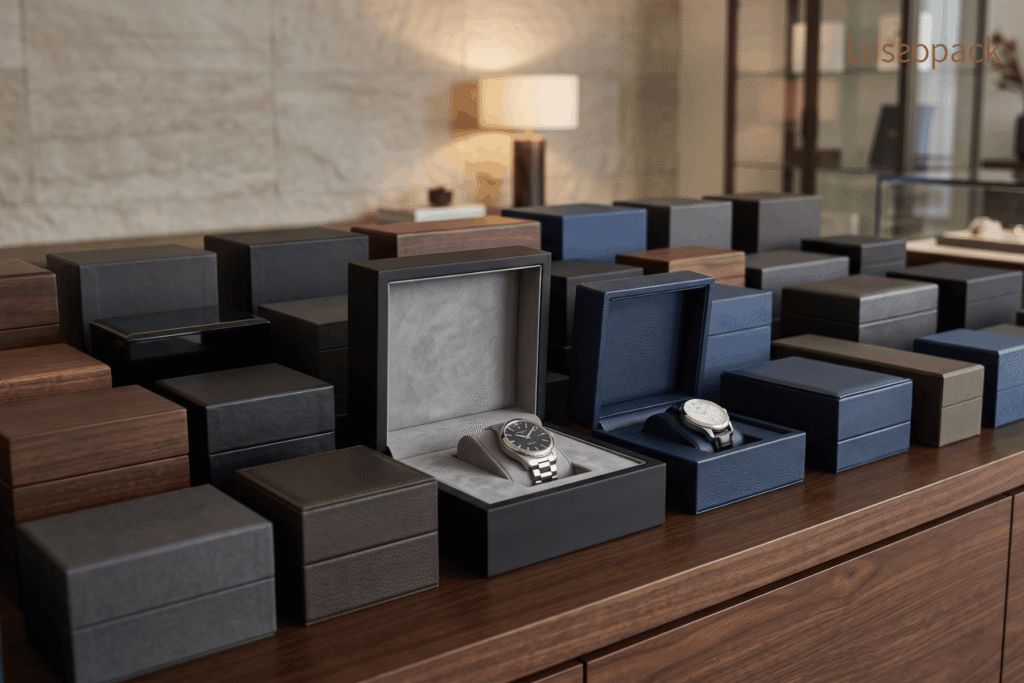
1. Start With the Order Volume, Not the Unit Price
One of the first questions a watch box supplier will ask is how many units you need.
This matters because wholesale packaging pricing is normally volume-based. A quotation for 500 units may look very different from one for 2,000, 5,000 or 10,000 units.
The lowest unit price is not always the most economical option, either.
A larger order may reduce the cost per box, but it also increases:
- upfront purchasing cost
- freight volume
- warehouse requirements
- inventory exposure
- the risk of holding outdated packaging if branding changes
Retailers should therefore consider how quickly the packaging will actually be used.
For example, if a retailer sells several watch collections with different box requirements, one very large order may not be as practical as several controlled production runs.
Before requesting a quotation, it helps to estimate annual usage and divide it by collection, store, product category or sales channel.
This gives the supplier a much clearer basis for recommending an appropriate production volume.
2. Understand MOQ Requirements for Swiss Retail Orders
MOQ or minimum order quantity, is one of the most important commercial factors in custom watch packaging.
The MOQ may apply to:
- the entire order
- each box size
- each colour
- each logo variation
- each interior configuration
- each packaging design
This distinction is important.
A supplier may quote an MOQ of 1,000 units, but that does not necessarily mean a retailer can split those units across five completely different designs.
For example, if a retailer wants:
- 400 black boxes
- 300 navy boxes
- 300 green boxes
The supplier may treat each colour as a separate production run.
That can affect pricing, tooling and production feasibility.
Swiss retailers should therefore ask suppliers to explain exactly how the MOQ is calculated before finalising a design.
For larger retail groups or brands with multiple collections, it may also be worth discussing whether some components can be standardized across several box styles. Shared structures, inserts or outer cartons can sometimes improve production efficiency.
3. Compare Pricing Tiers, Not Just One Quotation
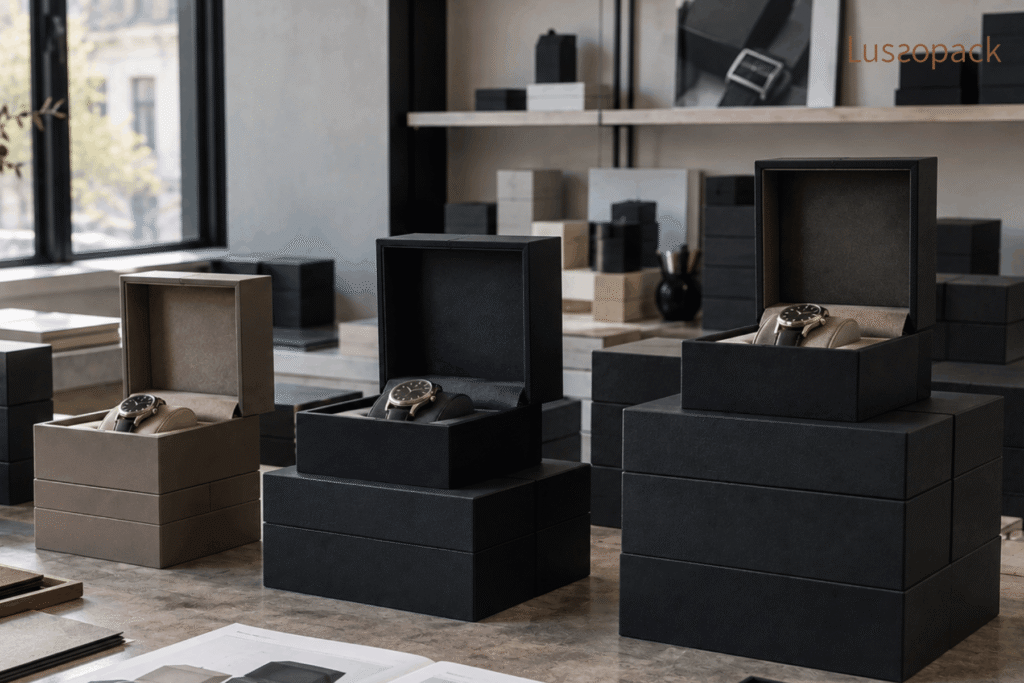
When sourcing watch packaging box wholesale, buyers should ask for more than one quantity tier.
Instead of requesting a price for only 1,000 units, ask the supplier to provide quotes for several order volumes, such as 1,000, 2,500, 5,000, and 10,000 units. This makes it easier to compare how the unit price changes as the order quantity increases.
Some production costs are fixed regardless of the order volume.
These may include:
- tooling
- mould development
- printing setup
- logo plates
- prototype development
- colour matching
- machine setup
As the order quantity increases, these fixed costs are spread across more units.
However, retailers should still compare the total commitment required at each level. Saving a relatively small amount per box may not justify doubling the inventory.
The objective should be to find the best commercial balance between unit cost, stock turnover and cash flow.
4. Separate Development Costs From Production Costs
The total packaging cost for custom watch boxes often includes expenses that are not reflected in the standard unit price.
Before approving an order, retailers should ask for a clear breakdown of one-time and recurring charges.
One-time costs may include:
- sampling
- tooling
- moulds
- dies
- printing plates
- embossing plates
- custom insert development
Recurring costs may include:
- box production
- printing
- wrapping
- inserts
- sleeves
- outer cartons
- assembly
Keeping these costs separate makes future reorders easier to evaluate.
If the same tooling can be reused, a second production run may have a different cost structure from the initial order.
Retailers should also confirm who owns the tooling once it has been paid for and whether it can be reused for future production.
5. Confirm What Is Included in the Quoted Unit Price
Two suppliers may quote similar prices while including very different things.
A unit price may or may not include:
- custom logo application
- interior inserts
- protective wrapping
- individual sleeves
- instruction cards
- outer cartons
- assembly
- packing for export
- palletisation
This is why procurement teams should compare quotations line by line.
For example, one supplier may quote a lower price for the box itself but charge separately for the insert and export packing.
Another may provide a slightly higher unit price that includes the finished box, insert, logo and final assembly.
The second option may ultimately be more cost-effective.
A clear specification sheet is useful here. It ensures that all suppliers are quoting against the same packaging requirements.
6. Treat Sampling as Part of Procurement, Not Just Design

For large wholesale orders, a sample is not only a design approval tool.
It is also part of the commercial risk-control process.
The sample should allow the retailer to assess whether the supplier can reproduce the agreed specification before full production begins.
Important points to check include:
- box dimensions
- opening and closing mechanism
- rigidity
- surface finish
- colour accuracy
- logo position
- foil or embossing quality
- insert fit
- watch fit
- cushion density
- edge finishing
- overall presentation
For premium and luxury watches, small inconsistencies can be noticeable.
A retailer should therefore avoid approving a sample based only on photographs where possible.
A physical sample gives the purchasing and brand teams a much clearer understanding of the finished product.
It can also be retained as an approved production reference.
7. Ask How Quality Control Works During Production
Quality control becomes more important as order volumes increase.
With a small sample run, issues may affect only a handful of pieces. With a wholesale production order, a repeated defect can affect hundreds or thousands of units.
Before placing the order, ask the supplier how quality is controlled at different stages.
This may include checks for:
- dimensions
- structural strength
- colour consistency
- printing alignment
- logo placement
- surface defects
- adhesive marks
- damaged corners
- insert fit
- opening mechanism
- final assembly
Retailers should also ask what happens if part of the production does not meet the agreed specification.
The process for handling defective units should be understood before shipping, not after the goods arrive in Switzerland.
For high-value packaging programmes, pre-shipment inspection can provide an additional level of control.
8. Check Production Capacity for Large Swiss Orders
A supplier may be capable of producing excellent samples but still struggle with a large production schedule.
This is especially relevant when packaging is required for:
- a collection launch
- a seasonal campaign
- a retail expansion
- a trade event
- a major wholesale delivery
Swiss retailers should ask whether the supplier has sufficient production capacity for the required quantity and deadline.
Important questions include:
- What is the standard production lead time?
- Does lead time change for larger orders?
- Is production handled in-house?
- Which stages are outsourced?
- Can the factory handle repeat orders at the same volume?
- Are there known peak production periods?
If timing is critical, retailers should build additional buffers into the schedule.
Packaging delays can hold up the delivery of finished watches even when the watches themselves are ready.
9. Plan Production and Delivery Lead Times to Switzerland
A common mistake is to focus only on factory production time.
If a supplier says production takes 30 days, that does not mean the boxes will arrive in Switzerland in 30 days.
The total timeline may include:
- design confirmation
- sample development
- sample shipping
- revisions
- final approval
- raw-material preparation
- production
- quality control
- export packing
- freight
- customs clearance
- final delivery
Depending on the order and shipping method, the full process can take significantly longer than the manufacturing stage alone.
Retailers should work backwards from the required delivery date and include sufficient time for both approvals and logistics.
10. Clarify Shipping Terms for Orders to Switzerland
Shipping terms can significantly affect the real cost of a wholesale watch-box order.
Retailers should confirm whether the supplier’s quotation is based on terms such as:
- EXW
- FOB
- CIF
- DDP
These terms determine who is responsible for different parts of the shipment and where the cost and risk transfer from supplier to buyer.
For example, an EXW quotation may appear inexpensive because the buyer is responsible for collection from the factory and most of the international logistics.
A delivered quotation may look higher but include considerably more of the freight process.
For procurement teams comparing several suppliers, the shipping basis should therefore be standardised wherever possible.
Otherwise, the quotations are not truly comparable.
11. Calculate the Total Landed Cost for Switzerland
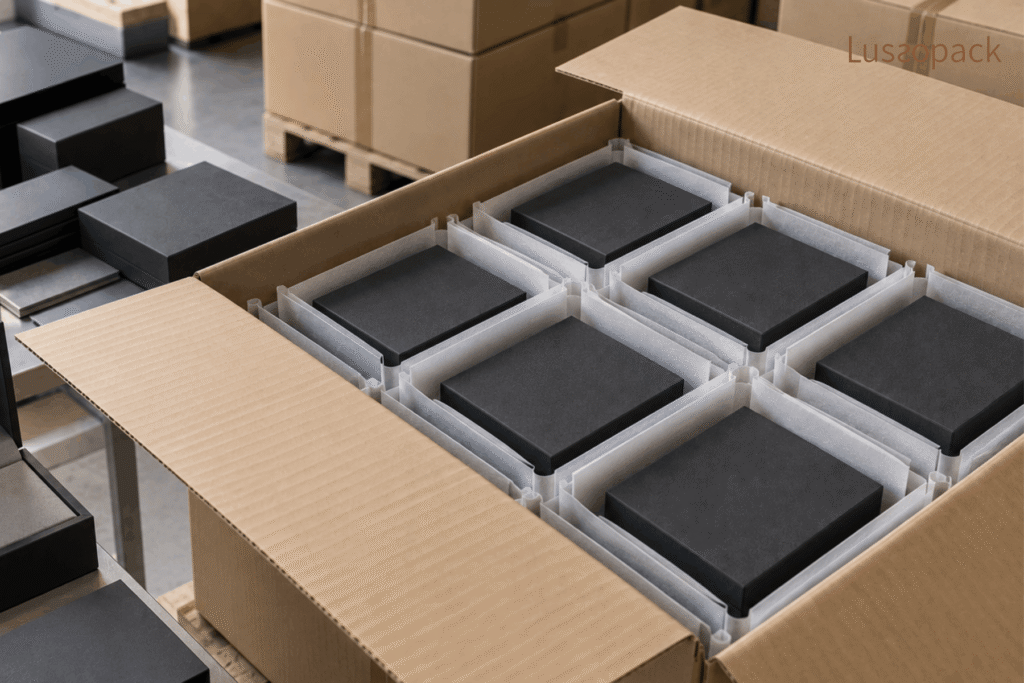
The factory price is only one part of the cost of sourcing watch boxes internationally.
Retailers should calculate the total landed cost before deciding which supplier offers the best value.
Depending on the transaction, the landed cost may include:
- product cost
- sampling
- tooling
- freight
- insurance
- customs-related costs
- import charges
- brokerage
- local transport
- warehousing
- handling
Packaging volume is particularly important because rigid watch boxes can occupy considerable shipping space relative to their weight.
A box with a low factory price may become much more expensive once freight is included.
For this reason, retailers should ask suppliers for carton dimensions, carton quantities and estimated shipment volume before confirming a large order.
This information can be used to obtain a realistic freight estimate.
12. Consider Storage Before Increasing the Order Quantity
Wholesale pricing often encourages buyers to increase volume.
However, rigid watch packaging requires physical storage space.
Before committing to a larger production run, Swiss retailers should consider:
- available warehouse space
- storage cost
- humidity and environmental conditions
- carton stacking limits
- handling frequency
- stock rotation
A very large order may produce a lower unit price but a higher overall storage cost.
This is particularly relevant for retailers with limited back-of-house space or multiple store locations.
If storage is a concern, discuss whether the supplier can support staged shipments.
For example, the packaging may be produced as one larger order but delivered in separate batches, depending on the supplier’s storage capabilities and commercial terms.
13. Plan Reorders for the Swiss Market
A good wholesale packaging arrangement should work beyond the initial production run.
Retailers should ask what happens when the boxes need to be reordered.
Useful questions include:
- Will the original tooling be retained?
- How long are production files stored?
- Can the same materials be sourced again?
- Can the same colour be reproduced?
- What is the reorder MOQ?
- Is the lead time shorter for repeat production?
- Can minor design changes be made without creating new tooling?
This is particularly important for watch brands that want packaging consistency over several years.
If a specific paper, fabric or coating is discontinued, the appearance of future packaging may change.
For long-running collections, it can be useful to select materials that the supplier expects to remain available.
14. Evaluate the Supplier as a Long-Term Production Partner
For a wholesale order, the relationship with the supplier matters almost as much as the individual box specification.
Retailers should look beyond the sample and assess whether the supplier can support ongoing commercial requirements.
A capable packaging partner should be able to provide clear information about:
- production capacity
- quality-control procedures
- material sourcing
- lead times
- export packaging
- documentation
- reorders
- design changes
- volume growth
Communication is also important.
Questions should be answered clearly, specifications should be documented and changes should be confirmed before production.
For Swiss retailers managing multiple watch lines, working with a supplier that understands repeat production can reduce procurement complexity over time.
15. Use a Commercial Checklist Before Placing the Order
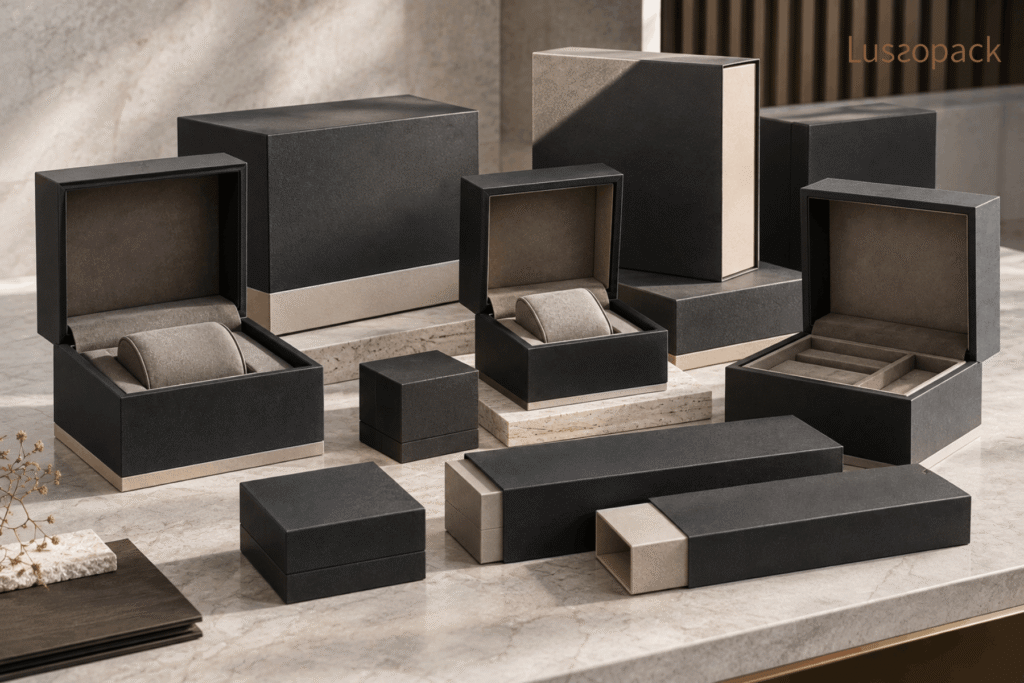
Before approving a wholesale watch-box order, the retailer should have a clear answer to the following:
- What is the final quantity?
- What is the MOQ per design or variation?
- What pricing tiers are available?
- What one-time tooling costs apply?
- What exactly is included in the unit price?
- Has the physical sample been approved?
- What are the quality standards?
- What is the production lead time?
- What is the total lead time?
- What shipping term applies?
- What is the estimated freight volume?
- What is the expected landed cost?
- Where will the packaging be stored?
- What are the reorder conditions?
- What happens if quality issues are found?
This turns the packaging decision into a structured procurement process rather than a simple price comparison.
Ordering Watch Boxes Wholesale With Greater Commercial Control
For Swiss retailers, watch packaging is not only about presentation. It is also a purchasing, inventory and logistics decision. Looking beyond the lowest unit price to factors such as MOQ, tooling, quality control, production capacity and freight can help reduce risk and improve long-term cost control.
A reliable supplier should offer consistent quality, transparent terms and dependable repeat production across future collections.
Planning a custom or wholesale watch packaging order? Lussopack can help you develop the right packaging from sampling to bulk production, with solutions tailored to your watches, brand and order requirements. Contact Lussopack to discuss your project and request a custom quotation.