Comparing quotes from luxury packaging manufacturers requires more than checking which supplier offers the lowest unit price.
Differences in materials, inserts, finishing, tooling, packing, and other inclusions can make two similar-looking quotes difficult to compare directly. The first step is to put every quote on the same basis, then calculate what you are actually paying for.
Here is how to compare luxury packaging quotes accurately before choosing a manufacturer.
1. Standardize the Specifications in Every Packaging Quote
Start by checking whether every luxury packaging manufacturer is actually pricing the same product.
A request for “1,000 custom rigid jewelry boxes with logo” leaves too much room for interpretation. Different manufacturers may calculate their quotations using different board thicknesses, papers, inserts, printing methods, or packing arrangements.
Before comparing prices, create a specification sheet that defines the same requirements for every supplier. It is also important to prep design files for custom packaging production so each manufacturer is working from the same artwork, dimensions and production information.
For example:
| Specification | Requirement |
|---|---|
| Box style | Two-piece rigid jewelry box |
| Finished size | 90 × 90 × 45 mm |
| Board | 1,200 gsm rigid board |
| Exterior | Textured specialty paper |
| Interior | Suede-effect lining |
| Insert | Velvet-covered die-cut insert |
| Logo | Gold foil stamping, centered on lid |
| Quantity | 1,000 units |
| Individual packing | Protective sleeve |
| Export packing | Corrugated export cartons |
Dimensions alone are not enough.
Terms such as “premium paper,” “velvet insert,” or “luxury finish” can describe materials at very different price and quality levels. Ask manufacturers to identify the actual specification they have used wherever possible.
If Supplier A has quoted 1,000 gsm board while Supplier B has quoted 1,400 gsm board, their prices should not yet be treated as directly comparable.
The first objective is not to find the cheapest quote. It is to establish a genuine like-for-like comparison.
2. Break Down the Packaging Quote Into Cost Components
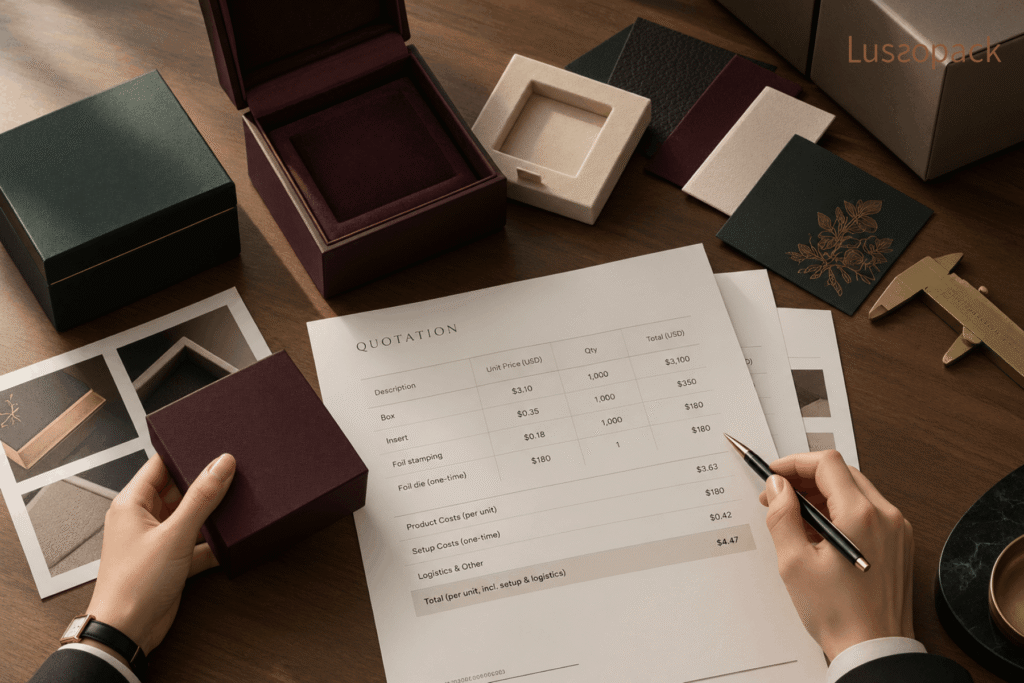
Once the specifications are aligned, separate the quotation into individual cost components.
A useful packaging quote should allow you to identify at least three types of costs:
Product costs
These are packaging costs that generally increase with every unit produced, including the box itself, insert, wrapping, printing, finishing, assembly, and individual protective packaging.
One-time setup costs
These can include dies, molds, printing plates, foil stamping dies, tooling, or other setup required to manufacture a particular design.
Project and logistics costs
These may include prototypes, samples, export cartons, freight, inspections, and other services associated with getting the packaging from the factory to the buyer.
This distinction matters because manufacturers structure their quotations differently.
One supplier might quote:
Jewelry box: $3.85/unit, including insert and foil logo
Another might quote:
Box: $3.10/unit
Insert: $0.35/unit
Foil stamping: $0.18/unit
Foil die: $180
The second quotation initially appears cheaper because $3.10 is the most visible number. Once the additional components are included, the comparison changes.
Do not compare headline unit prices until you know what sits behind them.
3. Separate One-Time Tooling Costs From Repeat Order Costs
This is particularly important for custom luxury packaging.
Tooling costs can make the first production run appear significantly more expensive than future orders. Depending on the design, these costs could include cutting dies, foil dies, molds, printing plates, or specialized tooling for inserts and structural components.
Suppose two luxury packaging suppliers provide these quotations for 1,000 boxes:
| Supplier A | Supplier B | |
|---|---|---|
| Unit price | $3.60 | $3.85 |
| Tooling | $450 | $150 |
| Production cost | $3,600 | $3,850 |
| First-order cost | $4,050 | $4,000 |
Supplier B is slightly less expensive for the first order.
But if the tooling can be reused:
| Supplier A | Supplier B | |
|---|---|---|
| Reorder unit price | $3.60 | $3.85 |
| Reusable tooling | $0 | $0 |
| Cost for another 1,000 | $3,600 | $3,850 |
Supplier A becomes less expensive on the reorder.
For a limited-edition collection, the first-order cost may be the more relevant number. For a core jewelry or watch collection that will be replenished for several years, repeat-order economics can matter considerably more.
Ask each manufacturer:
- Which tooling charges are one-time?
- Which setup charges apply to every production run?
- Can the tooling be reused without modification?
- How long will the manufacturer retain it?
- Will a design or size change require new tooling?
This gives you both a first-order cost and a repeat-order cost, rather than one number that hides the difference.
4. Identify Material Differences That Are Driving the Price
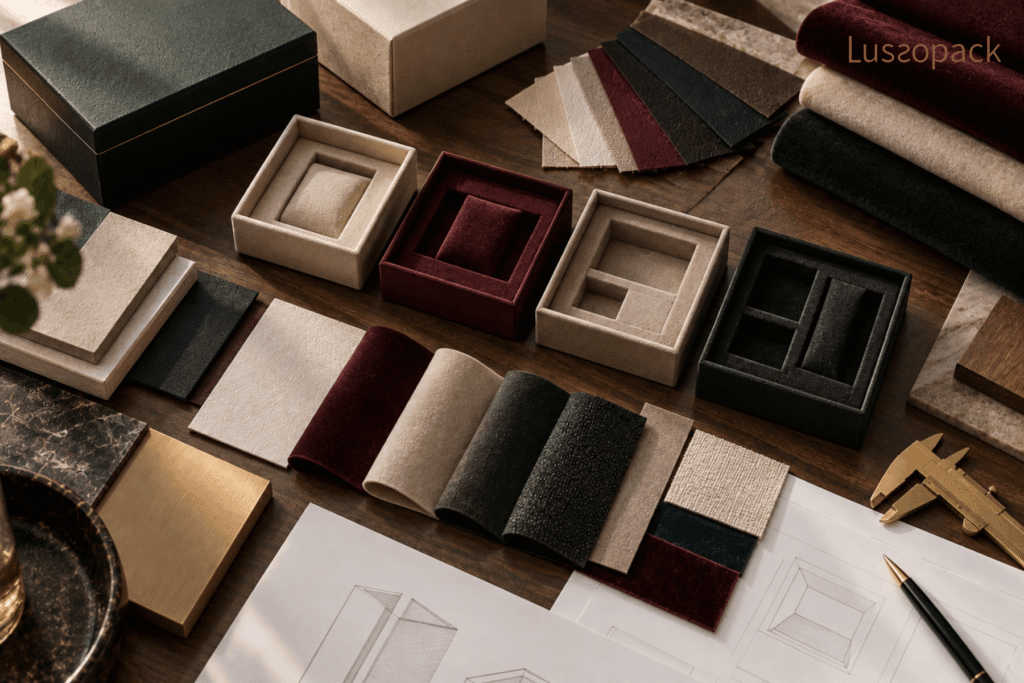
Even when quotes list the same components, the materials and construction may differ.
For example, two manufacturers may both quote a “velvet jewelry insert,” but they could be proposing different constructions:
- Foam with a velvet surface
- Die-cut EVA covered in velvet
- A formed insert with fabric wrapping
- A multi-component insert assembled by hand
They may look relatively similar in a rendering but behave differently in production and in use.
The same issue applies to exterior materials.
The same applies to exterior materials, board thickness, and finishing methods. Specialty paper, PU, fabric, and textile coverings can require different levels of material and manual work.
If prices vary significantly, ask which material or construction choices are driving the difference. You may be comparing two different packaging specifications rather than two prices for the same product.
If you are still defining the materials, finishes or box structure for your project, our luxury packaging guide provides a broader overview of the options available for premium packaging.
5. Recalculate Each Quote at the Quantity You Will Actually Order
Manufacturers often provide several quantity tiers because the cost per unit changes as production volume increases.
For example:
| Quantity | Unit Price |
|---|---|
| 500 | $4.70 |
| 1,000 | $3.90 |
| 3,000 | $3.25 |
| 5,000 | $3.05 |
The 5,000-unit price looks attractive, but it is only valuable if the business can reasonably use 5,000 units.
For luxury brands, excess packaging inventory creates its own costs. It occupies warehouse space, ties up cash, and creates a risk that packaging becomes obsolete after a branding update, collection change, or product redesign.
Instead of asking only:
Which supplier has the lowest unit price?
Ask:
Which supplier has the best cost at the quantity we can realistically use?
It can also be useful to request identical price breaks from each manufacturer, such as 500, 1,000, 3,000, and 5,000 units. This shows how each supplier’s economics change as your order grows.
A manufacturer that is competitive at 5,000 units may not be competitive at 500. Another may be particularly suitable for smaller production runs.
That difference can influence which supplier is appropriate for your current stage of growth.
6. Add Protective Packing Before Comparing Shipping Costs
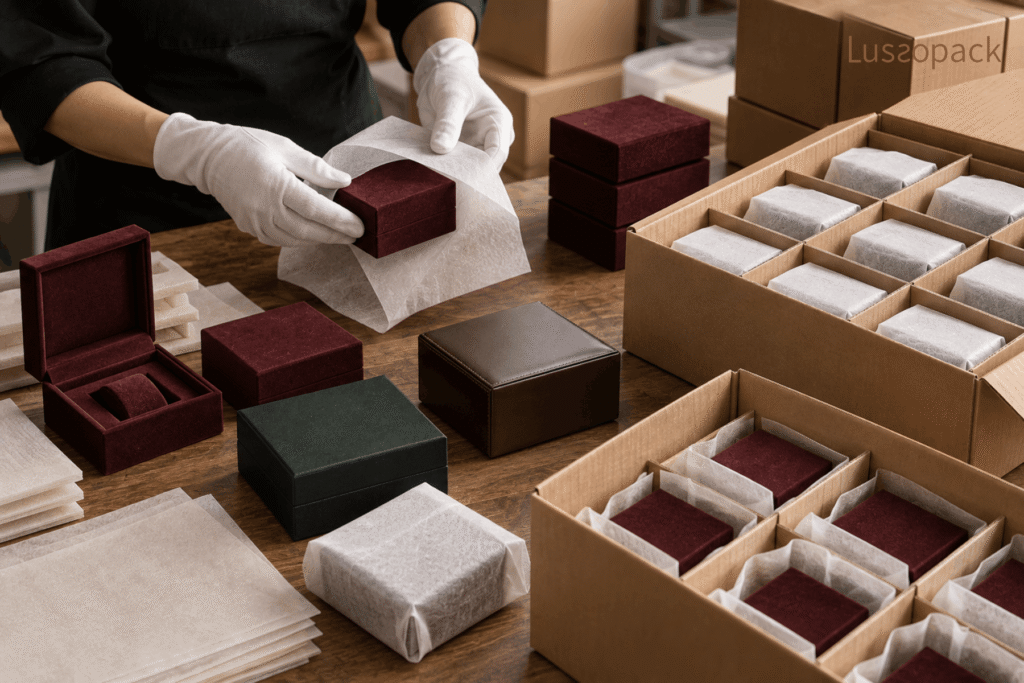
Velvet and leather jewelry boxes need careful packing because their surfaces can be marked, scratched, or compressed during shipping.
Manufacturers may use individual protective sleeves, wrapping, dividers, or inner cartons to prevent boxes from rubbing against each other. These materials add to the packing cost and can also increase shipment volume.
This is particularly important for velvet boxes, where pressure or friction can affect the surface, and leather boxes, where scratches or impressions may be visible on arrival.
Before comparing freight estimates, ask each manufacturer how the finished boxes will be protected and packed into export cartons. The lowest packing cost is not necessarily the most economical if it increases the risk of damaged packaging.
7. Convert the Packaging Quotes Into Landed Cost Per Usable Box
At this stage, you can move beyond the manufacturer’s quoted price and calculate a more meaningful figure.
A simplified calculation is:
Landed cost per usable box = (production + tooling allocation + sampling + export packing + freight + import/local costs) ÷ usable units received
The phrase usable units is important.
Imagine that Supplier A delivers 1,000 boxes at a lower landed cost, but 40 cannot be used because of visible finishing defects. Supplier B has a slightly higher total invoice but only five unusable pieces.
The effective cost of packaging available for sale is different from the invoice cost per manufactured unit.
For example:
| Supplier A | Supplier B | |
|---|---|---|
| Total landed cost | $4,000 | $4,150 |
| Units received | $1,000 | $1,000 |
| Unusable units | $40 | $5 |
| Usable units | $960 | $995 |
| Effective cost per usable box | $4.17 | $4.17 |
On the original quotations, Supplier A appeared cheaper.
After usable yield is considered, the advantage disappears.
You will not always know the rejection rate before working with a manufacturer, particularly on a first order. This is where samples, quality standards, inspection procedures, tolerances, and the supplier’s previous production experience become important parts of the commercial evaluation.
8. Compare the First Order and Reorder as Two Different Scenarios
Once the landed costs are calculated, run the comparison twice.
First Production Run
Include:
- Sample development
- Tooling
- Dies or molds
- Setup charges
- Production
- Packing
- Freight
- Applicable import and local costs
Repeat Production Run
Remove genuinely one-time costs, but retain recurring setup charges and any costs that must be paid again.
This is particularly useful for established luxury products.
A jewelry packaging quote that is relatively expensive during development may become more competitive after the tooling and structural design have already been established.
Conversely, a low first-order quotation does not guarantee attractive reorder pricing.
If the packaging will remain in production for several years, consider estimating the cost across multiple orders rather than judging the manufacturer on the first 1,000 boxes alone.
A Practical Luxury Packaging Quote Comparison
Consider three manufacturers quoting 1,000 custom jewelry boxes:
| Cost | Manufacturer A | Manufacturer B | Manufacturer C |
|---|---|---|---|
| Quoted box price | $3.40 | $3.75 | $3.20 |
| Custom insert | Included | Included | +$0.35 |
| Foil logo | Included | Included | Included |
| Tooling | $280 | Included | $420 |
| Protective sleeve | Included | Included | +$0.12 |
| Sample | $120 | $150 | $100 |
At first glance, Manufacturer C appears to offer the best price at $3.20 per box.
But once the insert and protective sleeve are added, its recurring unit cost becomes $3.67 before tooling and sampling are considered.
Manufacturer A remains at $3.40 per unit before its one-time costs, while Manufacturer B stays at $3.75 with tooling already included.
There still is not enough information to declare a winner.
You also need to compare materials, insert construction, foil specifications, export packing, freight, tooling reuse, and repeat-order costs. That is why quotations need to be normalized. The headline price is only the starting point.
Choosing Between Luxury Packaging Manufacturers
A useful quote comparison should eventually give you three numbers for each manufacturer:
First-order cost per unit
What the initial project costs after setup and development expenses are included.
Repeat-order cost per unit
What you are likely to pay once reusable tooling and development costs have been removed.
Estimated landed cost per usable unit
What each box effectively costs after production, packing, transportation, and expected usable quantity are considered.
From there, price can be assessed alongside material quality, craftsmanship, production capability, lead time, quality control, and communication.
For luxury jewelry and watch packaging, this approach is much more useful than simply choosing the lowest number on a quotation. It helps identify whether you are genuinely receiving a better manufacturing price or whether you are being quoted a different product, specification, or scope of work.
If you are comparing options for a new packaging project, Lussopack brings more than 30 years of hands-on industry experience to the process. With full-service, one-stop capabilities, flexible production volumes, global export readiness and a growing focus on sustainable packaging solutions, Lussopack can support projects from concept and material selection through sampling, production and delivery.
Quotations are developed around your box structure, materials, inserts, finishes, order quantity and production requirements, giving you a clearer basis for evaluating both unit cost and the wider cost of your luxury packaging project.
Speak with our team to discuss your packaging requirements and develop a quotation tailored to your project.