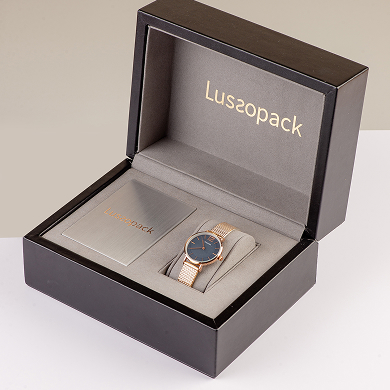
Launching a new watch collection involves far more than designing the timepiece itself. Every detail surrounding the product contributes to how customers perceive the brand, from marketing materials and photography to the packaging that accompanies the watch.
For many brands, watch packaging is one of the first physical touchpoints customers experience. Before the watch is worn, examined, or admired, the packaging sets expectations about quality, craftsmanship, and attention to detail.
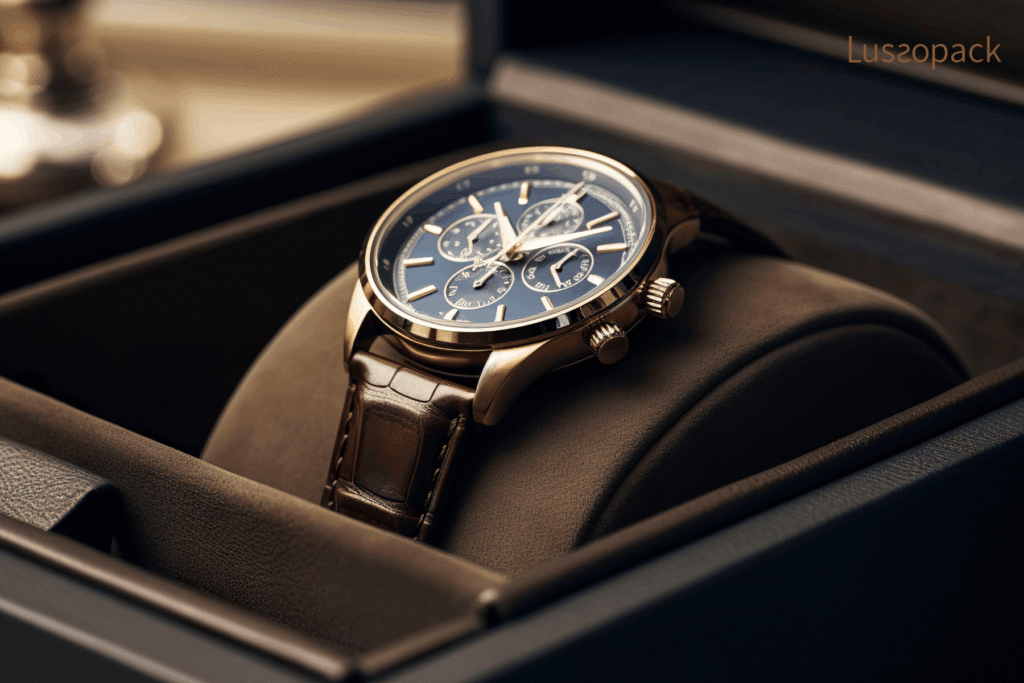
Whether you are introducing a limited-edition collection, launching a new luxury watch line, or preparing for retail distribution, selecting the right luxury watch packaging can play a meaningful role in the success of the launch.
This guide explores how to evaluate watch packaging, choose the right watch box design, and develop custom watch boxes that support both brand presentation and practical business requirements.
What Should Watch Brands Consider Before Choosing Product Launch Packaging?
Before getting into box styles and surface materials, it helps to establish a clear brief. The most common source of problems in packaging projects is not a bad supplier or an unrealistic budget; it is a brief that was never fully written down.
Four questions shape almost every meaningful packaging decision:
1. Brand positioning
How is this watch positioned in the market? A $300 watch sold primarily through e-commerce has different packaging requirements than a $3,000 watch sold through independent retailers and boutiques. Positioning determines the appropriate material tier, finish quality, and level of customization.
2. Launch goals
Is this a limited edition release? A flagship launch? A press and influencer seeding campaign? The goal affects how the packaging needs to perform. A box that photographs well for an unboxing video has slightly different priorities than one that sits on a retail counter for six months.
3. Customer experience
Who is receiving this box, and what do you want them to feel? The opening sequence, the interior presentation, and any included inserts all contribute to the moment the customer has with the product. That experience should be designed, not assumed.
4. Budget and production constraints
How many units are needed for the launch? Is there a fixed deadline? Is there storage capacity for overrun? These practical realities shape what is achievable, and understanding them early prevents expensive surprises later.
Getting clear on these four points before approaching a manufacturer means the conversation starts with substance rather than starting over from scratch at the sample stage.
How Is Product Launch Packaging Different from Retail Packaging?
This distinction matters more than it is usually given credit for. Watch packaging for an ongoing retail program and watch packaging for a product launch serve related but genuinely different purposes.
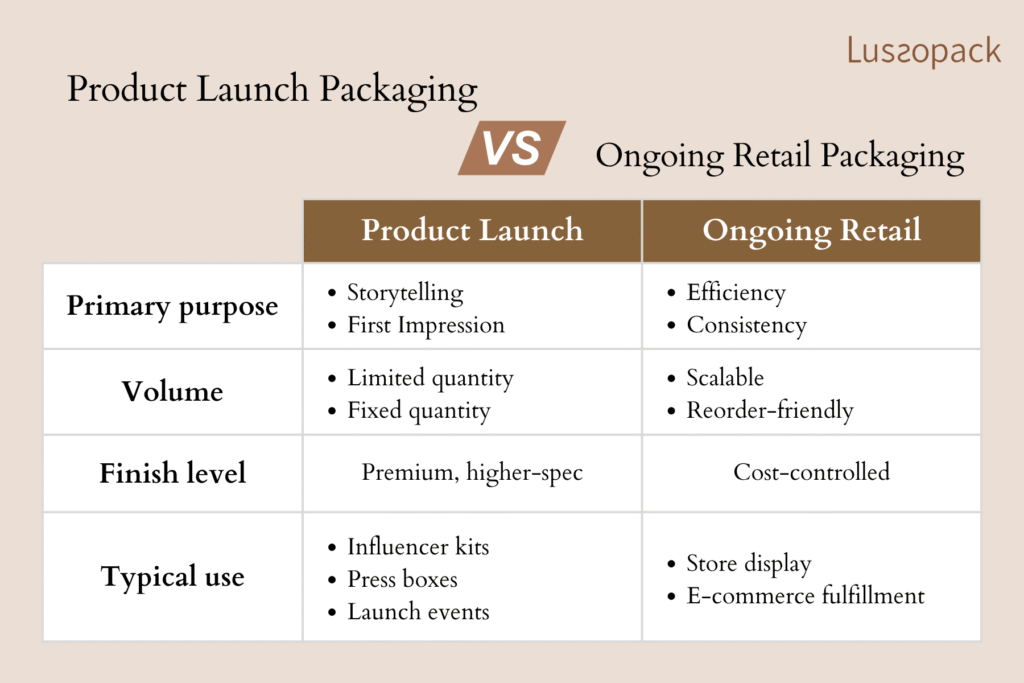
Watch launch packaging is essentially a brand statement in three dimensions. The brief for this kind of packaging should start from the brand’s visual identity and work outward to the physical object, rather than starting from a standard box format and applying a logo.
Product launch packaging for watches also tolerates a higher per-unit cost than everyday retail packaging because the quantity is smaller and the context is higher-stakes. A brand launching 500 watches can invest more per box than a brand producing 5,000 units for ongoing distribution. That flexibility is worth using intentionally. Understanding factors that influence packaging prices and cost calculation can help brands make informed decisions and avoid unexpected expenses during production.
What Type of Watch Box Works Best for a Product Launch?
There is no single format that suits every launch. The right box type depends on the context in which the packaging needs to perform.
1. Limited Edition Collections
Limited edition launches benefit from packaging that clearly communicates scarcity. Effective formats include numbered inserts, specialty surface materials that are not used in the standard line, or distinctive structures such as a deep tray with a separate lid. The goal is for the packaging to feel like part of the edition itself, not simply a container for the product.
2. New Luxury Brand Launches
For a brand entering the market for the first time, packaging plays an even bigger role in shaping its position. There is no existing customer relationship or brand history in the buyer’s mind, only the object in their hands. New luxury brands usually benefit more from conservative, well-executed packaging than experimental formats, with clean lines, quality materials, and precise branding. A packaging impression that feels cheap is much harder to recover from than one that feels understated.
3. Established Brands Releasing Flagship Models
When an established brand launches a flagship model, customer expectations are already shaped by the packaging the brand has used in previous releases. This creates both a challenge and an opportunity. The challenge is maintaining consistency with the brand’s existing visual identity. The opportunity is using the flagship launch as a reason to introduce premium details, such as foil accents, wood elements, or a ribbon pull, that are not included in the standard product line.
4. Influencer and Media Launch Kits
These require a different mindset entirely. The packaging is designed to be opened on camera, shared as content, and experienced by an audience watching a screen. That means the opening sequence matters as much as the finished state. Layers, reveals, and thoughtful insert placement all contribute to a more engaging unboxing. The box should also be robust enough to survive shipping to multiple recipients without arriving dented or compressed.
Which Materials Create a Luxury Watch Box Experience?
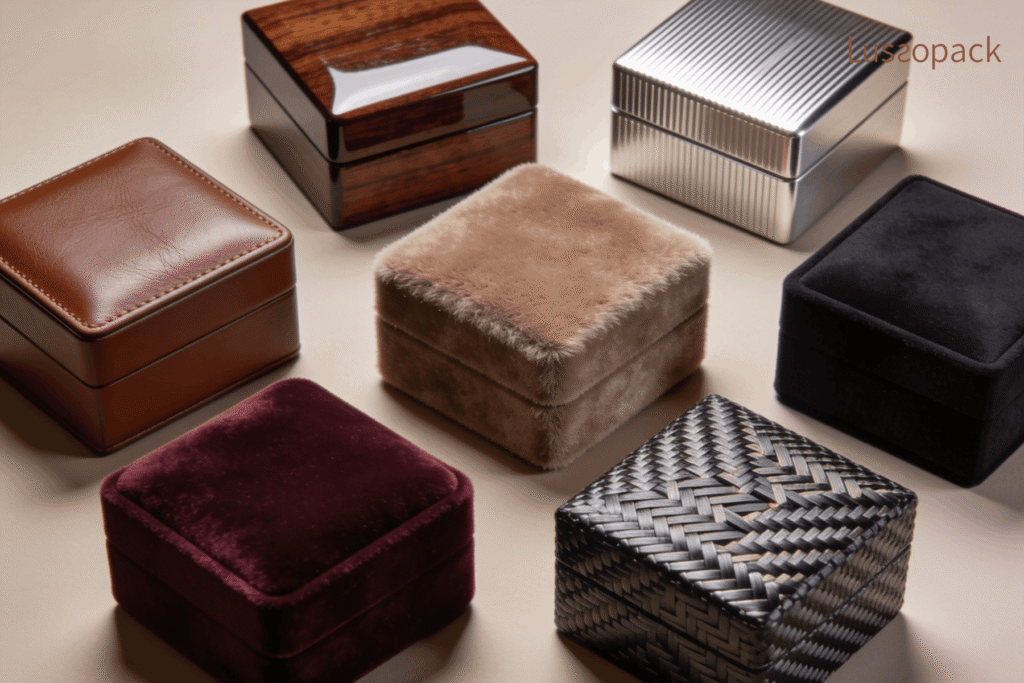
Material selection determines how packaging reads at every price point. Choosing the wrong material for a given tier is one of the most common ways packaging undermines a product’s positioning.
1. Leather and Premium PU
Full-grain leather is typically used at the higher end of the market, especially for watches priced above $2,000, where the packaging needs to reflect strong material quality. For most launches, premium PU is the more practical option. It works well with debossing and foil stamping, comes in a wide range of colors, and withstands repeated handling. Leatherette also offers many texture choices, from smooth finishes to pebbled and fine-grained surfaces.
2. Velvet and Suede Interiors
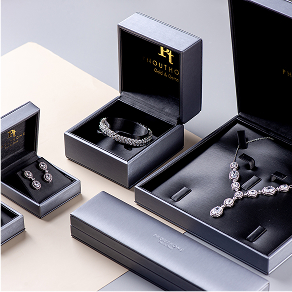
Interior lining material affects both the visual impression and how securely the watch is held. Velvet reads as traditional luxury and photographs well. Microsuede has a softer, more contemporary feel. Interior color is also an important brand decision. A pale cream lining against a dark exterior is a classic choice, but tonal or monochromatic interiors are becoming more popular for a modern look.
3. Rigid Paperboard
High-density chipboard forms the structural base of most quality rigid watch boxes. The difference between tiers comes from the materials applied over it and the precision of the construction, including square corners, flush joins, and consistent wall thickness. For most mid-tier and upper-mid-tier launches, a well-built chipboard box with quality exterior and interior materials is more than sufficient.
4. Wood Components
Wood inserts, lids, or outer shells appear more often in collector and limited-edition contexts. Walnut, maple, and bamboo are common options. Wood adds weight and a tactile quality that no fabric or leather surface replicates. It also adds cost and production complexity, so it is worth reserving for launches where that detail is genuinely part of the product story.
5. Sustainable Luxury Materials
Recycled board, FSC-certified materials, and plant-based surface alternatives are increasingly available without a significant quality compromise. For brands whose customer base cares about sustainability as a value, using certified materials and including a brief note about them in the insert is worth building into the brief.
For a deeper look at how materials compare across different packaging categories, the guide to choosing premium packaging materials covers the key trade-offs in practical terms.
How Much Customization Should a Brand Include?
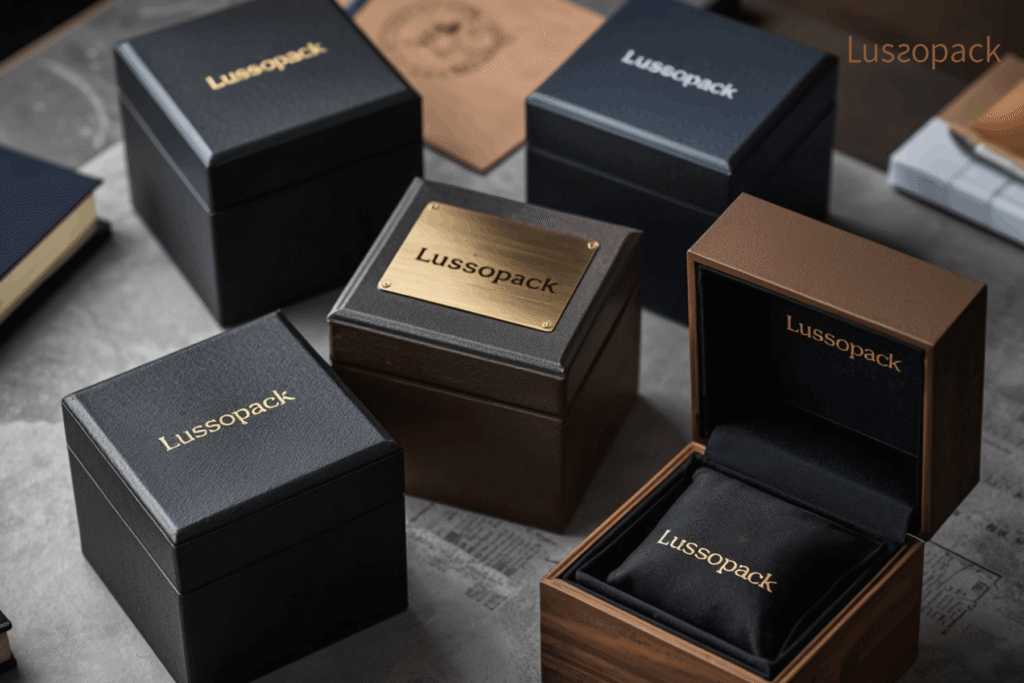
This is one of the most underdiscussed questions in packaging briefs. Brands often think about materials and dimensions, but less often think systematically about what customization to include and whether it is worth the additional cost.
1. Foil Stamping
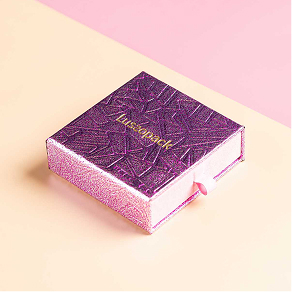
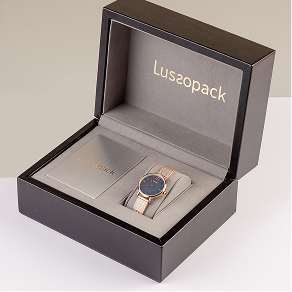
A foil-stamped logo on the lid exterior is the most common premium finish in watch packaging. Gold foil is the default, but rose gold, silver, and matte black all have strong applications depending on the brand’s palette. Foil reads as a quality signal at retail and photographs well, which makes it particularly valuable for launch packaging that will be shared as content.
2. Embossing and Debossing
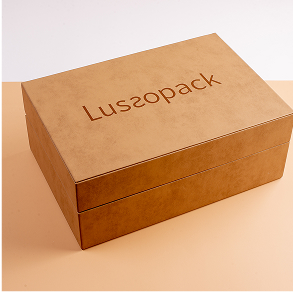
Embossed (raised) and debossed (pressed) finishes work well on leatherette and smooth paperboard. Debossing tends to produce cleaner results on fabric and textured surfaces. For fine-line logos, it is worth requesting a physical sample before committing to the technique, since line weight that works in print can close up or spread under pressure.
3. Metal Plates
A separate metal plate set into the lid, usually in brushed aluminium or a brass-tone finish, adds a three-dimensional effect that printed or foil finishes cannot fully replicate. It is also one of the most expensive finishing options and can extend production time. For a flagship launch or collector edition, it may be worth the investment. For a first-time brand launch with a limited budget, it is usually better to save this finish for later.
4. Printed Interiors
Printed base panels inside the box, such as a brand story, watch reference detail, or founder note, are increasingly used to carry the brand narrative into the packaging itself. Printed inserts can create a similar effect at a lower cost and are easier to update across different production runs.
5. Magnetic Closures
A magnetic closure on the lid adds a tactile moment to the opening experience that a standard hinge does not provide. For watches being seeded to media or influencers, this kind of detail matters because it affects how the unboxing feels and sounds on camera.
The practical question for any customization decision is whether the finish adds meaningful value to the brand experience or whether it adds cost without a proportional improvement. A well-executed deboss on a quality leatherette surface usually delivers more than an elaborate finish on a lower-grade base material.
When Should Brands Start Developing Watch Packaging?
The timeline question is where many launch packaging projects run into trouble. Custom watch boxes require multiple production stages, and each one takes real time.
6 Months Before Launch — Concept Development
This is when the brief should be written, manufacturer conversations should begin, and material shortlisting should happen. Having structural dieline options and surface material swatches in hand at this stage means the sampling process starts from a clear point of reference rather than an open brief.
4 Months Before Launch — Prototype and Revision
Physical samples should be reviewed in detail at this stage. This is the point to check cushion fit against the actual watch case diameter, test hinge tension, confirm color accuracy, and review logo reproduction. Most projects require at least one revision round, and building that time in is what separates a timeline that holds from one that compresses at the end. Before submitting final artwork, it is worth reviewing the requirements for design files for custom packaging production to avoid delays caused by file format or resolution issues.
2 Months Before Launch — Production Approval
Final sample approval should mark the completion of the development process. At this stage, production is already underway, and any changes can be costly and time-consuming. The ideal outcome is that no further revisions are needed, which is why careful review and decision-making during the earlier stages are so important.
1 Month Before Launch — Logistics and Fulfillment
Packaging is in transit or in a warehouse. Assembly, if needed, is planned. Shipping to retail partners or fulfillment centers is confirmed.
Counting back from a fixed launch date and mapping these stages is not complicated, but it requires starting the conversation earlier than most brands instinctively do.
How to Choose a Custom Watch Case Manufacturer
Evaluating custom watch box suppliers is a different decision from selecting a supplier for commodity packaging. For a product launch, the manufacturer is a production partner, and the quality of that partnership affects the quality of the outcome.
A useful evaluation checklist:
- Experience with luxury products: A manufacturer who primarily produces mass-market retail packaging may not have the material knowledge or quality standards required for luxury watch boxes. Ask to see examples of previous watch or jewelry packaging work.
- Material expertise: The manufacturer should be able to advise on material options based on the brief, not just offer a standard range. If they cannot discuss the trade-offs between surface materials or explain why a particular interior lining suits a given brief, that is a limitation.
- Sampling process: How samples are produced, how many revision rounds are included, and how quickly revisions are turned around all affect whether the project stays on schedule.
- Quality control: Ask how consistency is managed across a production run. The tenth box off the line should look the same as the first. Companies looking to source watch packaging for luxury brands often prioritize suppliers that can support custom development while maintaining consistent production quality.
- MOQ flexibility: Launch quantities are often lower than ongoing retail volumes. A manufacturer who can accommodate a first-order MOQ of 300 to 500 units with a clear path to reorder at higher volume is more useful for a launch project than one whose minimum starts at 2,000.
- International shipping capability: If the manufacturer is based outside the brand’s home market, understanding their freight options, typical transit times, and experience with customs documentation is important before committing.
A conversation about all of these points, before sampling begins, is the clearest signal of whether a custom watch case manufacturer is a good fit.
What Happens After the Product Launch?
This is one of the most overlooked questions in packaging planning, and it is worth thinking through before the launch happens rather than after.
Most watch brands face a decision point after a product launch. The three most common paths are:
1. Continue with the same packaging
If the launch packaging was designed with ongoing retail use in mind, this is the straightforward option. The same box, the same finish, reordered as needed. If the launch packaging was premium-spec specifically for the launch context, this path may not make economic sense for ongoing distribution.
2. Develop a production retail version
Many brands use the launch as a proof of concept and then develop a slightly more cost-efficient version of the packaging for ongoing retail use — same visual identity, same materials family, but optimized for larger-run economics. This is a common and sensible approach. It does require planning for the transition so that there is not a gap between the launch stock running out and the retail stock arriving.
3. Scale volume to reduce per-unit cost.
If the launch performs well and reorder volumes increase, the per-unit packaging cost decreases significantly. Understanding where those volume thresholds are before the launch helps with pricing and margin planning. For brands moving from launch quantities to wholesale volumes, the process for ordering wholesale packaging is worth reviewing, as the ordering process, lead times, and documentation requirements change at scale.
Planning for this decision in advance, even if it is only to identify the most likely path forward, helps ensure the brand is prepared when demand increases. It reduces the risk of facing packaging shortages or delays at the exact moment when product demand is at its highest.
Summary
Good launch packaging is not the most expensive packaging. It is packaging that does three things at once: it reflects the brand’s positioning accurately, it creates a memorable moment at the point of opening, and it can be developed and produced within the time and budget available.
The brands that get this right are not the ones with the largest packaging budgets. They are the ones that start the packaging brief early, ask specific questions about materials and customization, review physical samples before approving production, and think beyond the launch date to what comes next.
For brands seeking tailored watch packaging solutions, Lussopack works closely with watch and jewelry businesses to develop custom packaging that balances presentation, protection, and practical manufacturing requirements. Whether you’re preparing a limited-edition launch or building a long-term packaging program, our team can help guide material selection, structural design, branding details, and production planning to support your goals. Get in touch to explore what a custom solution for your launch could look like.